Preview
Reflecting on IEP Supports, Services, and Placement
As you explore the core components of an Individualized Education Program (IEP), it's essential to reflect on how supports, services, and placement decisions translate into real-life outcomes for students.
The IEP is not just a document; it is a comprehensive plan that guides instruction, supports student growth, and ensures access to education in the least restrictive environment. Understanding how these elements work together is crucial for creating an effective and meaningful IEP that truly meets the needs of the student.
The D.A.T.A. Model for Determining Services
D: Define the Present Levels
Gather current data on the student’s performance in key areas (e.g., academic, behavioral, social). For example, if a student is consistently struggling with math, you might look at their test scores, progress monitoring, classroom work, and teacher observations. This tells you exactly where they are performing right now.
Example: John is a 4th grader performing at a 2nd-grade level in math based on recent assessments.
A: Analyze the Gaps
Compare the student’s present levels to where they should be according to grade-level standards. This shows you the gap in their skills and helps you understand what they need to catch up.
Example: John should be solving 4th-grade multiplication problems, but he’s still working on basic addition and subtraction. This gap tells you what areas need extra focus.
T: Target Specific Services
Use the data to decide what type of special education services are needed to address the gap. These services can be specialized instruction (like small group math support), accommodations (like extra time on tests), or related services (like speech therapy if communication is a barrier to learning).
Example: Based on John’s gap, the IEP team decides he needs 180 minutes per week (30 minutes per day) of specialized math instruction in a small group setting (pull out or resource), focusing on foundational math skills. He also gets extra time on tests to reduce anxiety.
A: Adjust as Needed
Regularly monitor the student’s progress through updated data (e.g., progress reports, quizzes) and adjust the services if they aren’t making enough progress.
Example: After three months, John’s data shows improvement in addition and subtraction, so the team decides to reduce his small group math time but keeps the accommodations for test-taking.
Example: Determining Services for Jack
During an IEP meeting for Jackson, a 4th grader with ADHD and a specific learning disability in math, his special education team worked to determine the appropriate services to ensure his academic success. After reviewing his Present Levels of Performance (PLP), it became clear that while Jackson had strong verbal skills, he struggled significantly with attention and retaining math concepts in a traditional classroom setting. His teachers noted that Jackson often needed more time to complete assignments and benefited from hands-on learning experiences.
Based on this data, the team decided to provide Jackson with 180 minutes per week of specialized math instruction in a resource room, where he would receive small group, targeted support using manipulatives and interactive tools. To further support his needs, they added related services, such as 30 minutes per week with the school counselor to work on organizational skills and managing focus. Additionally, accommodations like extended time on tests and frequent breaks during independent work were included to help him manage his attention.
Regarding state testing, the team determined that Jackson would participate in the regular state assessments but with accommodations such as extended time and small-group testing. These specific, tailored services and accommodations ensured that Jackson had the tools, support, and environment needed to access the curriculum and assessments effectively, helping him build confidence in math and stay engaged in his learning without falling behind.
Measuring Progress Towards Goals and Objectives
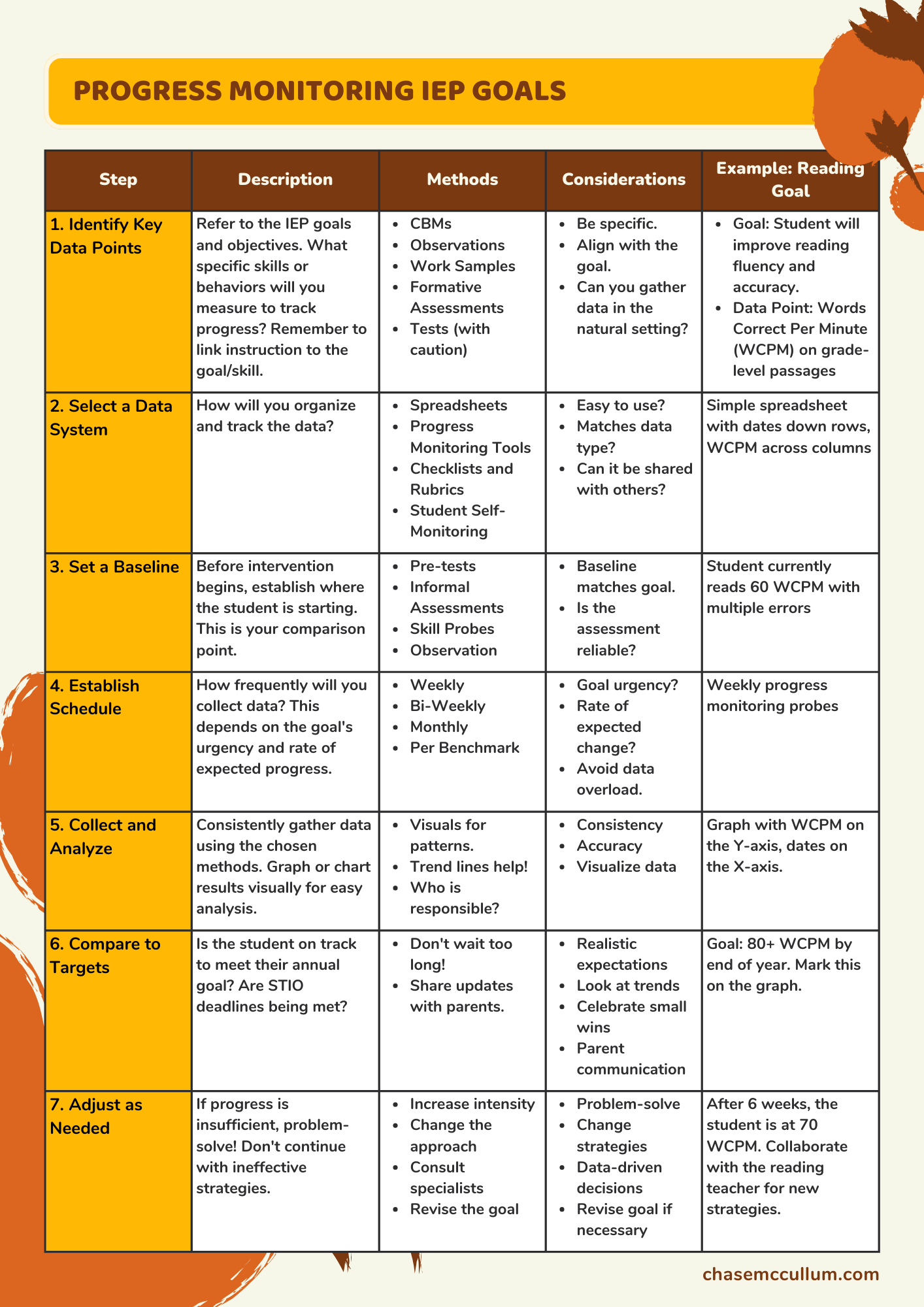
Measuring progress is a critical component of the IEP process, as it ensures that the student is making appropriate strides toward their goals. This involves regular monitoring, using various assessment tools, and making data-driven decisions.
Progress Monitoring Tools: Progress is tracked through a combination of standardized tests, curriculum-based measurements (CBMs), teacher observations, and sometimes student self-evaluations. Each of these tools provides valuable data that helps educators assess whether the student is on track to meet their goals and if any adjustments are necessary.
Strategies for Effective Monitoring: Visual tools like graphs and charts can help track and display progress over time, making it easier to identify trends and make informed instructional adjustments. Regularly reviewing data with the IEP team ensures that all members are aligned and that any necessary changes to the educational plan are made promptly.
Challenges in Progress Monitoring: Consistency in data collection methods and schedules can be challenging, as can balancing thorough data collection with the demands of daily teaching. It is important to have clear timelines for data collection and review, and to ensure that all team members understand their roles in the monitoring process.
Transition Services in the IEP: Guidance for Special Educators
What are Transition Services?
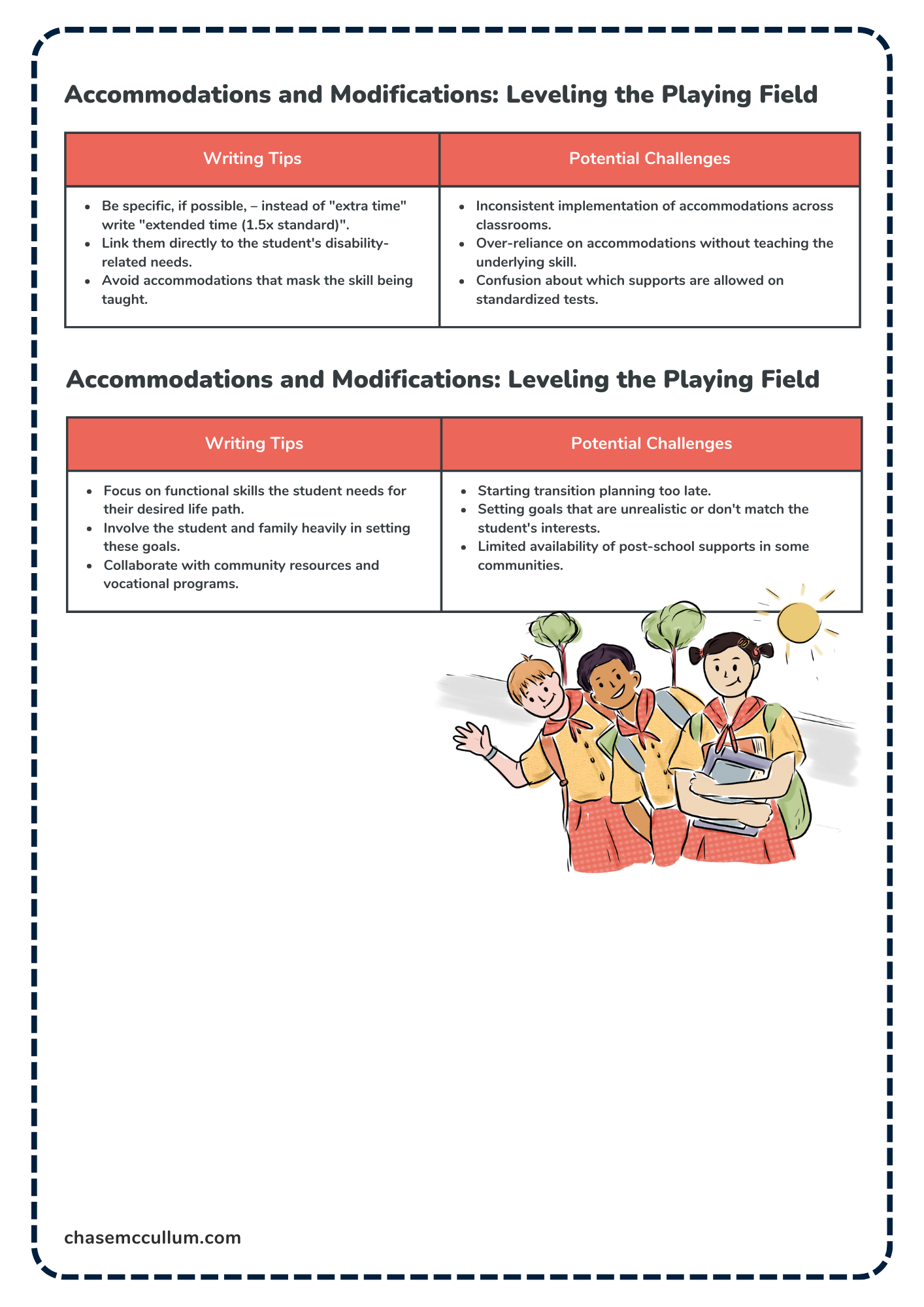
Transition services are a coordinated set of activities designed to help students with disabilities move from school to post-school life, including higher education, employment, and independent living. These services are required in the IEP starting at age 16 (or younger, depending on the state) and are essential for preparing students for life beyond school.
Key Components of Transition Planning:
Student-Centered Planning: Transition goals should be based on the student’s strengths, preferences, and interests. Engage the student in discussions about their future goals, such as attending college, getting a job, or learning independent living skills.
Age-Appropriate Transition Assessments: Use assessments to gather information about the student’s interests, abilities, and needs in areas like vocational skills, daily living, and social interactions. These assessments guide the development of measurable postsecondary goals.
Postsecondary Goals: IEPs must include clear, measurable goals for after high school. These can include goals related to education, training, employment, and independent living.
Example: “After graduation, Sarah will attend a two-year community college to pursue a degree in graphic design.”
Services and Activities: Include specific transition services and activities that will help the student reach their goals. These can include job training programs, internships, life skills instruction, or college application support.
Example: “John will participate in a job-shadowing program at a local business to gain work experience in the retail industry.”
Collaboration with Outside Agencies: Collaborate with community organizations, vocational rehabilitation services, and other agencies that can provide support during the transition to adulthood.
Why Transition Services Matter:
Transition services ensure that students with disabilities are equipped with the skills, knowledge, and experiences needed to succeed after high school. By incorporating these services into the IEP, educators can help students build a pathway to a meaningful and independent life.
Key Takeaways
Comprehensive Supports and Services: The IEP must include a detailed plan for specialized instruction, related services, accommodations, and modifications that are directly linked to the student’s needs and goals. These supports are essential for enabling the student to access the curriculum and make progress.
Regular Progress Monitoring: Continuous assessment and data collection are crucial for tracking student progress and ensuring that instructional strategies remain effective. Regular review of data allows for timely adjustments to the IEP as needed.
Informed Placement Decisions: Placement should be determined by data and should aim to provide the most inclusive setting possible while still meeting the student’s needs. Regular review and input from the entire IEP team are essential for making informed placement decisions.
By focusing on these aspects of IEP development, you can create a plan that not only meets legal requirements but also truly supports the student’s growth and success in their educational
Services and Supports in an IEP
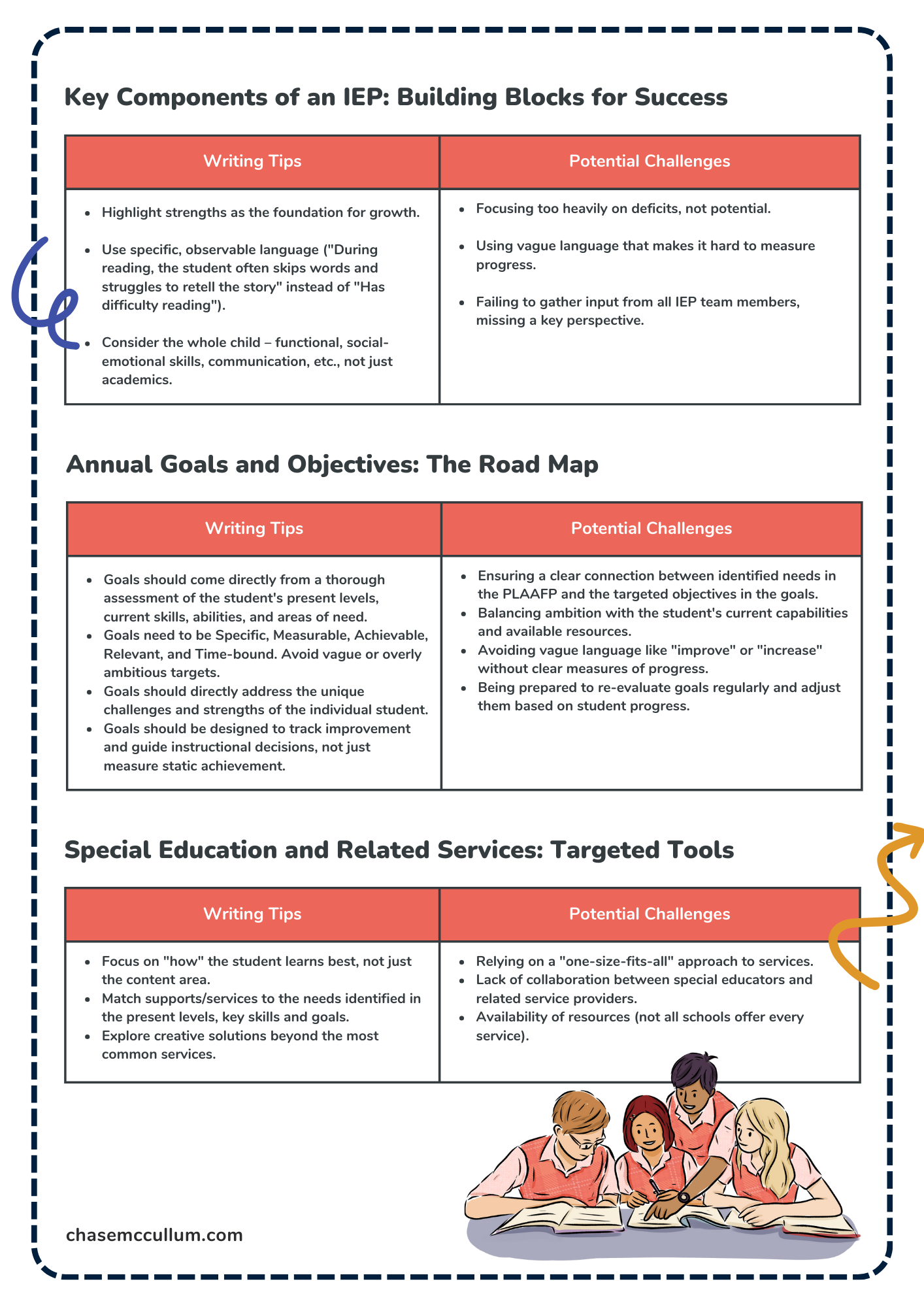
The services and supports outlined in an IEP are designed to help students achieve their goals by providing the necessary assistance and adaptations that address their unique needs. These services include specialized instruction, related services, accommodations, and modifications.
Specialized Instruction and Related Services: This includes tailored educational approaches such as small-group instruction, one-on-one support, and the use of specific teaching methods that align with the student’s learning style. Related services might include speech therapy, occupational therapy, or counseling, which support the student’s overall development and help address specific challenges related to their disability.
Accommodations and Modifications: Accommodations change how a student learns or demonstrates knowledge without altering the learning expectations, such as providing extended time on tests or using assistive technology. Modifications, on the other hand, adjust what the student is expected to learn, such as simplifying assignments or reducing the number of tasks to better match the student’s abilities. The goal is to level the playing field, ensuring the student can access the curriculum and demonstrate their understanding effectively.
Examples and Strategies: Some examples of services and supports include a phonics-based reading intervention, speech-language therapy for articulation, and the use of a calculator during math tests. Strategies for implementing these services include matching supports to the specific needs identified in the present levels, exploring creative solutions beyond common services, and focusing on how the student learns best, not just the content area.
Placement and the Least Restrictive Environment (LRE)
Placement decisions in an IEP are guided by the principle of the Least Restrictive Environment (LRE), which aims to place students in settings where they can interact with their non-disabled peers as much as possible while still receiving the supports they need.
Continuum of Placement Options: The IEP team must consider the full range of placement options, from full inclusion in the general education classroom to more specialized settings. The goal is to find the most inclusive setting where the student can be successful, with appropriate supports in place.
Making Data-Driven Decisions: Placement decisions should be based on data rather than convenience or historical practices. Regular review of placement is necessary to ensure that it continues to meet the student’s evolving needs. Input from all team members is crucial in making these decisions, ensuring that the placement aligns with the student’s IEP goals and overall educational needs.
Challenges in Placement: Balancing the need for inclusion with the need for specialized instruction can be difficult. Ensuring that the appropriate supports are available in the mainstream classroom and navigating limited resources within the school or district are common challenges that require careful planning and collaboration.